Digital Beamsplitter for high-precision DIE bonding
Digital image overlay for greater flexibility and direct visual control during alignment
With the Digital Beamsplitter, Tresky offers an innovative option for the visual alignment of high-precision DIE bonding processes. Instead of combining the images using a traditional optical beamsplitter, image superposition is performed entirely via software. This reduces additional optical and mechanical variables in the beam path while simultaneously creating new possibilities for challenging alignment tasks.
Two camera perspectives – one shared alignment image
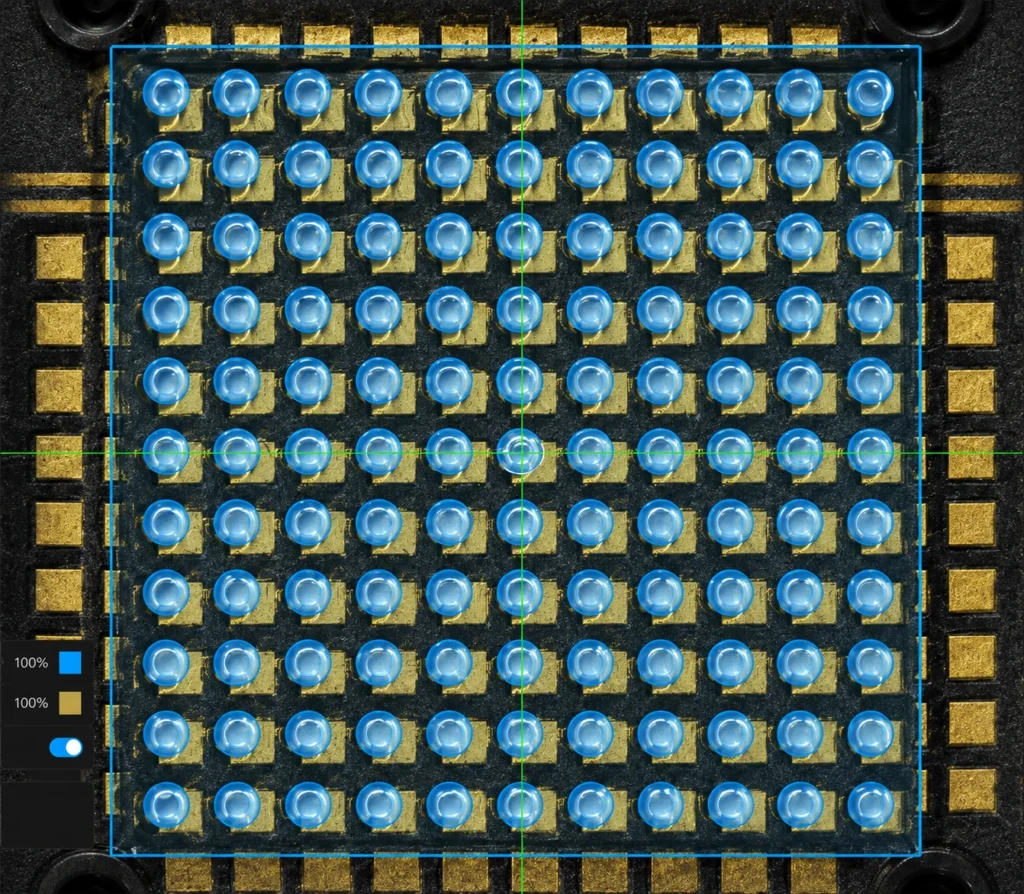
The up-looking camera captures the chip, while the down-looking camera captures the substrate or the target position. Both images are subsequently digitally merged and displayed to the user in a single alignment image.
This makes the chip structure, target structure, and any misalignment immediately visible. Alignment can be performed directly using X, Y, and theta. The operator receives direct visual feedback on how the chip and substrate are actually positioned in relation to each other.
See the chip. See the target. Align both.
Digital alignment without an additional optical beam splitter
In a traditional beam splitter, different camera perspectives are combined using a physical beam splitter. The glass required for this is located directly in the optical path. This can reduce the available light output and cause additional optical effects such as reflections, ghost images, or focus shifts. In addition, the mechanical-optical assembly must be precisely adjusted.
Tresky’s Digital Beamsplitter does not require physical beam splitting. As a result, the light intensity available to each camera is not divided by an additional beam splitter, and the full sensor resolution can be utilized. At the same time, the sensitive mechanical-optical adjustment of a beamsplitter prism is no longer necessary.
Your benefits at a glance
No physical light splitting via an additional beam splitter
Utilization of the camera sensor’s full resolution
Elimination of ghost images or focus shifts caused by beam splitter glass
No adjustment required for a mechanical-optical beam splitter
Direct visual inspection of the chip and target structure
Flexible software-based image display
Use of previously captured chip structures even after they have been physically covered
Flexible image display via software
Digital image processing offers additional options for customizing the display to suit the specific application. Parameters such as transparency, scaling, zoom, contrast, brightness, and rotation can be adjusted via software. In addition, additional overlays can be integrated into the alignment image.
As a result, the display is no longer determined exclusively by the physical optics. Different components, structures, and alignment tasks can be flexibly accommodated via the software.
Alignment even with concealed chip structures
A particular advantage of the Digital Beamsplitter becomes apparent when relevant chip structures or alignment marks are concealed by the pickup tool after pickup. At this point, a purely optical system reaches a fundamental limit: What is no longer physically visible cannot be optically imaged.
The Digital Beamsplitter can capture the relevant chip structure immediately before pickup and save it as a reference. After the chip is picked up, this image is superimposed on the current live image of the substrate. As a result, the information relevant for alignment remains available, even though the corresponding structure on the actual component is already obscured.
More than just a digital replacement for the traditional beam splitter
The technology therefore does more than simply digitally replicate the function of an optical beam splitter. Rather, the software-based image processing lays the foundation for additional functions and new alignment strategies that cannot be implemented, or can only be implemented to a limited extent, with a purely optical system.
For demanding DIE bonding applications
The Digital Beamsplitter is particularly well-suited for applications where precision, flexibility, and a high degree of visual process control are critical. These include, in particular:
R & D
Prototyping
High-mix/low-volume manufacturing
Photonics
Optoelectronics
Advanced Packaging
Digital alignment instead of optical compromises
With the Digital Beamsplitter, Tresky combines mechanical precision with intelligent digital process support. Direct visual inspection of the chip and target structure, flexible image display, and the ability to use previously captured and subsequently obscured structures for alignment provide additional degrees of freedom for high-precision DIE bonding processes.
Would you like to know if the Digital Beamsplitter is suitable for your DIE bonding application?
Talk to our experts about your components, alignment requirements, and process needs.